Modern Marketing is about solving a multitude of different variables to achieve one supreme goal – brand growth.

Think of every time you identified the correct issue, and asked the right question YET the problem persisted because one was troubleshooting the wrong variable or an unrelated or insignificant aspect that is NOT the real contributing factor to the issue in the first place.
You could be a brand marketer, campaign creator, digital specialist, CMO, business owner, or social media maven – whatever area of marketing you work in, for sure there are variables you deal with that contribute to the success (or failure) in your KRAs.
Today’s post is about a well-regarded technique that the best modern marketers have learned to apply to a variety of problems or challenges.***
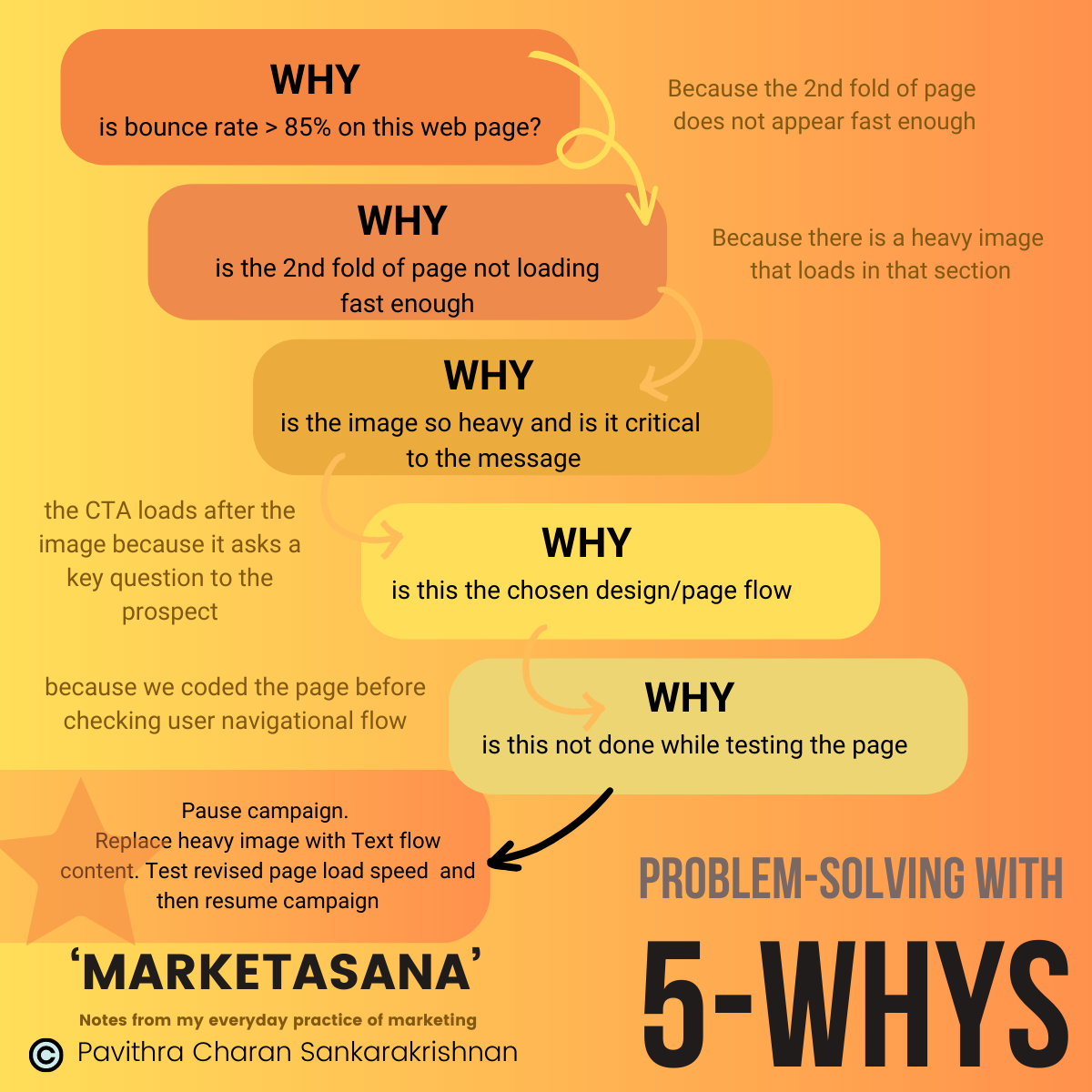
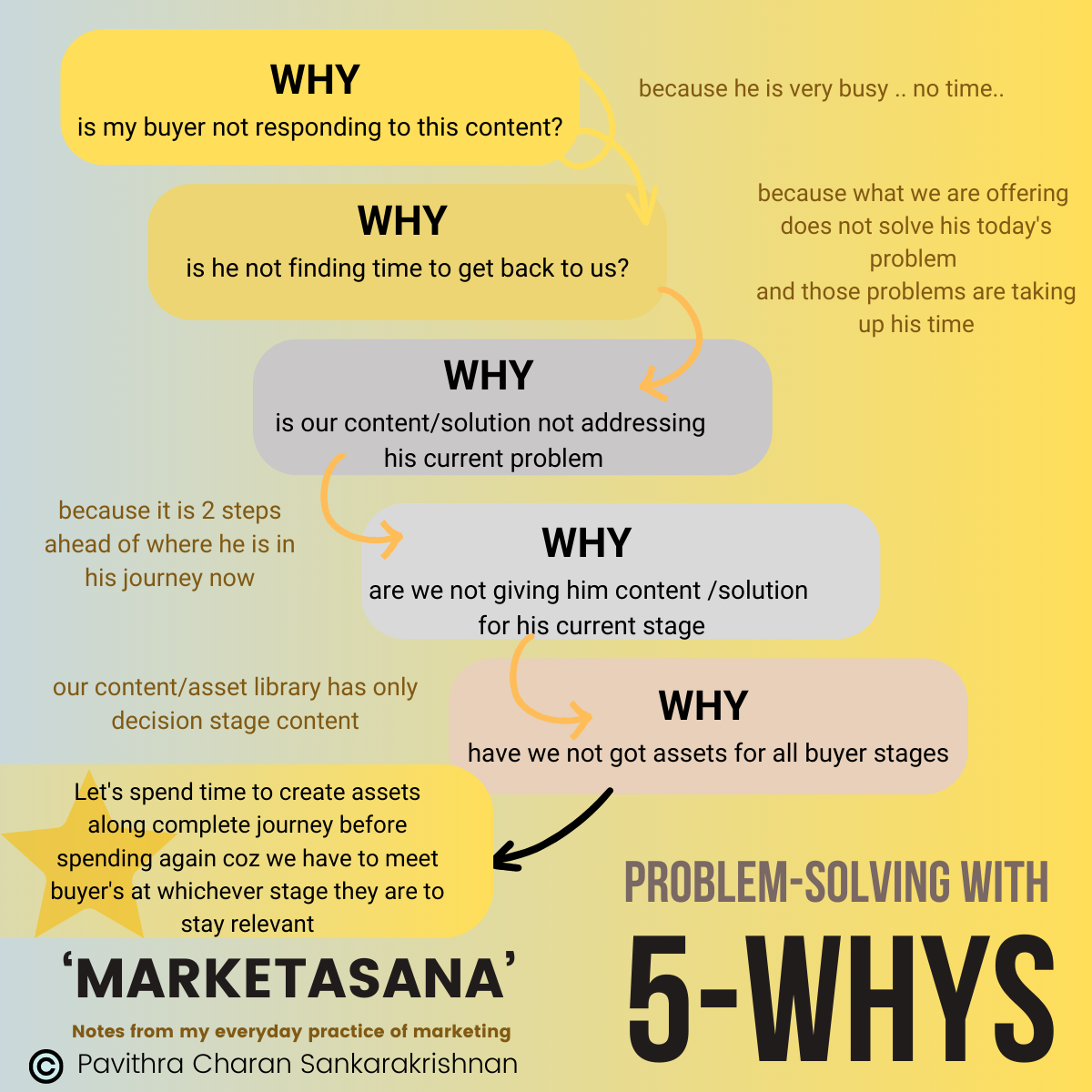
One of the tried and tested methods of ’cause and effect’ or root-cause analysis is the FIVE-WHYs technique. It is as simple as it sounds – ask WHY at every step, until you get to the bottom of the root cause of the issue. That does not necessarily make it easy! When you don’t stop with the first step, and keep asking the right WHY at every stage, the iterative technique states that by the time you ask the FIFTH WHY, you would have arrived at the ultimate cause of the issue, thereby uncovering the real underlying problem that needs to be fixed.
This has been a go-to method in a variety of situations. To demonstrate this visually, I have picked two situations in marketing (from yesterday’s Let’s Start with WHY post) and shown how a typical FIVE-WHY analysis would proceed in each of those instances. Of course, these are hypothetical in the sense the situations are drawn from my everyday work, but the real answers to those WHYs could be very different or varied based on the actual situation and all the variables involved. But the principle remains the same.

Ask WHY. Repeatedly.
Till you get to the root cause.
And then you can FIX the right problem and hence get the right results.
**About the FIVE-WHYs technique:
It is an iterative interrogative technique that was first developed by Sakichi Toyoda, the Japanese industrialist, inventor, and founder of Toyota Industries in the 1930s. Since then, it has found its way into fields far and beyond the automotive and manufacturing industries into every realm of management including marketing.
 Pavithra